Top 6 Things to Consider When Buying a Safe: A Buyer's Guide

Buying a safe starts with what you need to protect. I recommend choosing the fire and burglary protection your belongings need, then comparing size, locks, installation and total cost. A safe for household documents has a different job from one protecting valuable watches, so the best choice depends on what you plan to store and where you’ll put it.
I’ll walk you through six things to consider when buying a safe, then recommend three models for different needs based on those factors.
Guardian Safe & Vault has been in business since 2018, and we are an authorized reseller of some of the best home safes in the industry. We offer free shipping as standard and do not charge sales tax. We can also help you compare protection ratings, sizes and lock options so you can choose a safe that suits your needs.
If you want to see our recommendations first, jump straight to the three models we recommend.
1. What Do You Need to Protect?
List what will go inside the safe, including the largest items and anything you expect to add. Then identify the main concern: heat damage, theft or someone gaining access without permission. That gives you a useful starting point for choosing the type of safe.
| What You Are Storing | What to Prioritise | What to Check Before Buying |
|---|---|---|
| Passports, certificates and paper records | Fire protection suitable for paper | Temperature class, duration and room for folders |
| Jewellery, watches, cash and precious metals | Burglary resistance, with fire protection where needed | Independent rating, anchoring and your insurer's requirements |
| Backup drives and other sensitive media | Protection specified for the exact media | Temperature and humidity limits, plus a separate backup |
| Firearms | Prevention of unauthorised access and suitable storage space | Lock operation, mounting and room for fitted accessories |
| Business cash deposits | Controlled deposits and restricted retrieval | Deposit opening, anti-fishing features and who can open the main door |
Use product categories to narrow the search, then check individual specifications. A jewellery safe may have drawers that suit your collection, but the lining says nothing about burglary resistance. A gun safe still needs enough room for your firearms in their actual configuration. For that decision, see our gun safe buying guide.
2. Protection Ratings: Fire, Burglary and Water
Choose a fire-resistant safe when heat damage is the main concern, a burglary-resistant safe when theft is the main concern, and a safe rated for both when the contents need both forms of protection. Fire and burglary resistance are assessed separately, so evidence for one does not establish the other. UL's fire-testing guidance explicitly distinguishes its fire tests from its burglary tests.
Take a household storing passports alongside valuable watches. A paper fire rating answers part of the brief, but it leaves the theft question unresolved. A burglary-rated safe may protect valuables from theft, but unless it has a documented fire rating, you can't assume it will protect them from heat damage. A combination burglary and fire safe is the category to investigate, with both claims checked independently.
Do not use steel thickness or weight as a substitute for fire-test evidence. Likewise, a long fire rating does not tell you whether a safe can resist a determined theft attempt.
Understanding Fire Ratings
A safe's fire rating describes how long it met a specified internal temperature limit under defined fire-test conditions. Compare the test standard, temperature class and exposure duration together. “Fireproof” is a product description. You still need the details behind the claim.
For example, a UL Class 350 one-hour classification combines a 350°F internal temperature limit with a one-hour fire exposure rating. UL describes these as separate parts of the certification label.
Under UL 72, Class 350 is intended for paper records. Class 150 and Class 125 address more heat-sensitive records and include humidity limits. Do not assume that a paper-rated safe protects every hard drive, photograph or electronic device. Check the product details on our website to see whether the safe is suitable for what you plan to store.
Check the product description for the safe's test provider, fire-test standard, duration and temperature class, or ask us if you need help finding those details. If impact protection matters for your installation, check whether it was included in the testing or ask us to confirm.
Compare durations within a comparable test and temperature class. A headline “two-hour” claim is difficult to evaluate without those details. UL also states that its controlled fire exposures do not represent every possible building fire. A rating is test evidence, not a promise that the contents will survive any incident.
For the terminology behind the labels, see our guide to safe fire ratings.
Burglary Ratings and Security Claims
A burglary rating describes a safe's resistance to specified attack methods under defined test conditions. Choose a rating that addresses the theft risk of your contents and meets any requirements set by your insurer. For high-value storage, I would include independently rated safes in the shortlist and confirm any insurance conditions before choosing a model.
UL 687 tests how well a safe resists a break-in. TL-15 and TL-30 ratings cover attacks on the door and front face. TL-30X6 covers attacks on all six sides. Resistance to cutting torches has a separate classification.
To earn a TL-15 or TL-30 rating, a safe must resist entry for 15 or 30 minutes of active attack during the specified test. This is called net working time: preparation and pauses do not count towards those minutes. The rating shows the test duration the safe passed, not the point at which it will necessarily fail.
Construction Ratings and RSC Test Levels
B-rate and C-rate describe construction rather than a timed attack test. The table below shows the conventional steel thicknesses for each rating. Check the product description for the exact model's construction details, or ask us for help.
| Rating | Construction or Test Requirements | Attack-Test Time |
|---|---|---|
| B-rate | Conventionally a 1/2-inch steel door and 1/4-inch steel body. | No timed attack test is established by the B-rate label alone. |
| C-rate | Conventionally a 1-inch steel door and 1/2-inch steel body. | No timed attack test is established by the C-rate label alone. |
| UL RSC Level I | One technician uses a specified set of common tools to test resistance to entry. | 5 minutes of attack time. |
| UL RSC Level II | Two technicians use a more demanding tool set. The container must also resist a 6-square-inch opening in the door or front face. | 10 minutes of attack time. |
| UL RSC Level III | Two technicians use a more demanding tool set than Level II, with a smaller, 2-square-inch opening criterion. | 10 minutes of attack time. |
UL's RSC classifications describe tested performance under UL 1037. The RSC label alone does not tell you the door or body steel thickness, so check those measurements in the product description. UL also describes a drop test for containers weighing 750 lb or less, with an exemption for products supplied with suitable mounting provisions and installation instructions.
RSC Level III is more demanding than Level II even though both use a ten-minute test. The tools and entry criteria differ, so compare the full classification rather than the minutes alone. Ask us if you need help comparing a model's construction and tested protection.
Check what a certification covers. A certified lock is useful information, but it does not by itself establish a burglary rating for the complete safe.
Water Resistance and Moisture
A fire rating does not establish a safe's water resistance. To assess water protection, look for a separate claim supported by defined test conditions. Request the water test conditions, including depth and exposure duration, and check whether the claim has any installation restrictions.
Consider the proposed location's exposure to leaks and flooding. A convenient basement position deserves closer scrutiny if water can collect there. Also ask about the manufacturer's moisture-control instructions for the contents you intend to store.
3. What Size Safe Do You Need?
Choose a safe whose usable internal height, width and depth accommodate your largest items, their cases or folders, and expected additions. Check that those items also fit through the door opening. The exterior dimensions determine whether the safe fits the room, and the internal dimensions determine whether it fits your belongings.
Measure the largest item first. Our safe sizing guide can help you work out how much space you need. A document folder needs enough width and depth to sit properly. A watch box needs clearance above the shelf. For firearms, account for optics, stocks and other fitted accessories rather than relying solely on the advertised gun count.
Check the product listing for the layout of shelves, drawers and door storage. Then check whether you can remove the largest item without emptying everything else. Leave room for additions you reasonably expect to make, but do not sacrifice the protection you need simply to buy a bigger cabinet.
4. Which Safe Lock Should You Choose?
I generally recommend a good-quality electronic keypad lock because modern models offer quick access and are easy to use. Still, about half of our customers prefer a mechanical combination dial. A fully mechanical lock needs no batteries or electrical power and has no electronic components vulnerable to an electromagnetic pulse (EMP), which may matter to you. Some electronic locks are also tested for EMP resistance, so ask us about the options if that is a concern.
Check the exact lock model and any certification, then compare the access methods:
- Mechanical dial: opens by turning the dial through a combination and needs no batteries. On many models, changing the combination requires a special change key and access to the back of the lock with the safe door open. We recommend having a qualified safe technician handle the change and test the new combination before closing the door.
- Electronic keypad: provides quick access with a code that you can change yourself. Features can include penalty lockout, which temporarily blocks further attempts after repeated incorrect entries, and separate codes for multiple users. Most models have an external battery compartment, so you can replace the battery while the safe is closed. Others use an external emergency-power connection. Available features depend on the lock model.
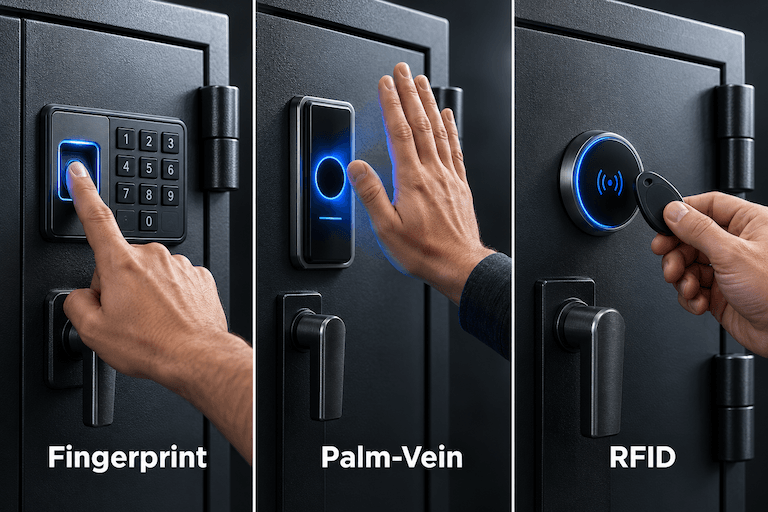
- Biometric access: lets you open the safe using fingerprint or palm recognition, depending on the model. The benefit is convenient access without entering a code each time. Biometric access does not, by itself, make the safe more resistant to burglary.
- Key lock: offers straightforward access with a physical key, without batteries or a code to remember. You need to keep the key secure and store the spare somewhere separate from the safe. If a key is lost or stolen, replacing the key alone may not restore security. The lock may need to be rekeyed or replaced, depending on its design. Ask us about the options for your model.
For a business, choose a lock that suits how your team needs to use the safe. Separate user codes let employees have their own access codes, dual control requires two authorised users to approve opening, and an audit trail records lock activity. These features vary by model. The product page lists the available functions, and you can ask us for help choosing the right setup.
Our comparison of safe lock types covers the options in more detail.
5. Placement, Delivery and Anchoring
Install the safe where the floor can support its loaded weight, the manufacturer-approved anchoring method can be used and the door has enough clearance to open. Confirm that the delivery team can reach that position before ordering. Keeping the safe out of casual view is useful, but concealment should not take priority over secure mounting.
Check Access and Floor Support
Check the whole delivery route: entrance width, steps, tight turns, floor surfaces and access to the final position. Give the installer the model's weight and dimensions, including any projections.
For an upstairs room or suspended floor, have a qualified professional assess the proposed location if load capacity is uncertain. The safe's weight alone is not enough information to determine whether a floor is suitable.
Confirm the Anchoring Method
Ask the installer to confirm the anchoring method for the safe and the substrate. Use the manufacturer's designated fixing points and instructions. Do not improvise holes through a fire-resistant body or assume that a heavy safe needs no securing.
If you are renting and cannot make permanent fixings, resolve that constraint with the property owner and supplier before buying.
6. How Much Should You Spend on a Safe?
Budget for the lowest total installed cost that meets your protection, capacity and access requirements. Include delivery, final positioning, anchoring and necessary lock options in that comparison. A useful spending limit depends on what you are storing and where the safe will be installed, so the purchase price alone is not enough.
Request an itemised quote covering the safe, delivery service, final positioning, stairs where applicable, anchoring and any lock upgrade. Confirm exactly where the delivery team will leave it. Delivery to the property and installation in an upstairs room are different services.
If the total exceeds your budget, compare smaller models that still meet your requirements before reducing the protection level. I would spend on the required ratings and proper installation ahead of decorative finishes or interior accessories.
Ask what the warranty actually pays for, too. Replacement of the safe, locksmith labour, removal and redelivery are separate costs. If you are comparing a used safe, include inspection, lock servicing and transport in the calculation. If you are replacing an old safe, also plan how to dispose of it.
Three Safes Worth Shortlisting
Here are three suggestions that may meet your needs. You can check out our full range of home safes here.
Hollon HS-310E: Compact Document Storage
The Hollon HS-310E is a compact electronic-lock safe with a listed two-hour fire rating. Its interior measures 8 inches high by 12.33 inches wide by 9.25 inches deep, with 0.53 cubic feet of capacity. It weighs 81 lb and includes a bottom anchoring hole and concrete fixing hardware.
I would shortlist the Hollon HS-310E for passports, certificates and a modest amount of paperwork when space is limited. Measure your folders carefully: a document fitting on its own does not mean its protective folder will fit comfortably.
Main limitation: this is a fire-focused recommendation, not a substitute for a documented TL burglary rating when storing high-value contents. Plan to secure it properly.
Gardall 1612-2: More Room for Paper Records
The Gardall 1612-2 offers a UL two-hour fire label, an adjustable shelf and a listed 1.3 cubic feet of storage. Its interior measures 16 inches high by 12 inches wide by 11.75 inches deep. At 290 lb, it also needs more delivery planning than the Hollon. Mechanical and electronic lock options are listed, so confirm the configuration you are ordering.
I would choose the Gardall 1612-2 over the Hollon HS-310E when extra internal height and adjustable storage are needed to organise several sets of household or office records.
Main limitation: the UL fire label should not be read as a TL burglary rating. If theft protection is driving your purchase just as much, assess that requirement separately before choosing it.
AMSEC CEV1814: TL-15 Burglary Protection With Fire Resistance
The AMSEC CEV1814 AmVault combines a UL-certified TL-15 burglary rating with listed 120-minute fire protection. Here at GSV, we offer it with an ESL10XL electronic lock as standard, adjustable steel shelves, 1.6 cubic feet of capacity and a weight of 854 lb.
The AMSEC CEV1814 is the model I would investigate first among these three for jewellery, watches or precious metals where resistance to a tool attack is a priority. Confirm that its rating meets your particular security and insurance requirements.
Main limitation: its weight makes access, floor suitability and professional positioning major purchase considerations. Settle the installation arrangements before ordering.
Your Pre-Purchase Checklist
Before ordering a safe, confirm its protection ratings, suitability for the contents, usable dimensions, installation arrangements, access method and total installed cost. Use these six questions to check your final shortlist:
- Protection: What evidence supports the exact model's fire and burglary claims?
- Contents: Is the safe suitable for the items you intend to store?
- Fit: Will the contents fit through the opening, and will the safe fit along the delivery route?
- Installation: Who will position and secure it, and what does that service include?
- Access: How will authorised users open it, change access and recover from a lock problem?
- Total cost: What is the complete price, including delivery, installation and selected options?
Guardian Safe & Vault is an authorized seller of some of the leading home-safe brands in the industry. For help choosing a safe that suits your needs, visit our Contact Us page. Tell us what you plan to store, your available space and your budget, and we can help you compare suitable options.